Walter Parks: When Buddha’s Around

Walter Parks Plays

Walter Parks Plays

All my friends are treasures as far as I’m concerned. Take Walter Parks, one of America’s finest singer-songwriters. Walter stands well over six feet tall. He wears classic “old school” hats which enhance his dapper choices: polished boots, tailored jackets, and colorful shirts that any fashionista would envy.A vintage guitar is his essential accessory. You’re likely to see a 1953 or 1957 Gibson ES 175, 1965 Fender Jazz Bass, 1967 Guild Starfire Bass, or if you’re lucky, a 1929 Tenor banjo. 

Walter collects old instruments like car buffs collect vintage automobiles. He spots forgotten gems lying in moldy basements with bodies scratched and three strings missing. It would be safe to say Walter Parks is in the resurrection business.   

Walter’s songs are as well constructed as his guitars. Like a good poem, his music layers in your imagination and remains with you long after his songs are over.IMG_6020

During his concerts, you’ll travel to New Mexico, “She says New Mexico is where she’s gotta go, cause she’s gonna die in Carolina.” His ethereal voice and chord combinations relax you into meditation, “Like something sacred, like something beautiful, like something so divine.” 

IMG_2508He’ll take you back in time to date night in New York City, “We walk into the Roxy, we walk into a dream, go-gos are dancing above the clouds, or, so it seems.” He’ll sing the story of the southern preacher who drives a powder-blue Lincoln and falls in love with a hippy chick who wears a cowboy hat and a sheer sun dress. The preacher’s “done for” when the hippy chick tells him “she gets more booty when Buddha’s around.”

Even though, Walter  has circled the globe, loves the road, speaks French, and has IMG_6038appeared on the big stages like Carnage Hall, Madison Square Garden, and the Cannes Film Festival, he is an original American musician from the cracker lands of Northern Florida. His finger is on the pulse of what makes our country great. Enjoy his tunes: www.walterparks.com. 


The Top 17 Reasons Why the World Needs You to be an Artist

IMG_5251Yesterday, during my first morning in Asheville, I had coffee with Court McCracken, a visual artist and blogger. We met at Clingman Café in Asheville’s River Arts District. Court has a growing blog called Art Nurture. Since I’ve been blogging a bit, I was curious about any new tips she might have. 

She told me she’d been researching Copyblogger for ideas on how to write compelling subject headlines. She said, that’s where she learned about The Reason Why strategy. For practice she posted: The Top 17 Reasons Why the World Needs You to be an Artist.

IMG_1372I liked #10 the best:
“The World doesn’t need any more crud.” 

Court’s list reminds us of things we already know. Click here to read it. 


Reflection on James Nachtwey, War Photographer

IMG_7266Here’s hoping a warm breeze brushes your face. Brooklyn trees have finally started to bloom.  Two broad winged hawks flew by yesterday on their way to Prospect Park. Nesting season has begun.   


Do you know the photojournalist James Nachtwey? He is considered the best war photographer in the world. Last Friday, I had the privileged of facilitating the weekly TEDxNewYork conversation salon. It was my job to choose a talk from the TED online video archive.  I choose Nachtwey’s 2007 TED prize acceptance talk:  My Photographs Bear Witness. 

I picked the talk for two reasons: 1) there’s a scene in it that change the way I think about my role as a poet; 2) I was afraid to show the talk to a large group of New Yorkers (60 or so) for fear the graphic images would turn them off. 

My fears were unfounded. More than one person referred to the image that had changed me. A seasoned photojournalist framed Nachtwey very well when he asked the group: “Do you have the courage to lift your camera?” 

When he said it, I wondered if I did; I hoped so. What about you, do you have the courage to lift your camera? 

I concluded the evening by reciting some lines from Yeats’ poem, “The Second Coming.” All told, it was an inspiring hour on the last Friday of the month. Watch the talk and you’ll understand why: My Photographs Bear Witness. 


Never Sorry

Illustration credit:  Tom Kovak

Illustration credit:
Tom Kovak

Last night I streamed NEVER SORRY a documentary film about the Chinese artist Ai WeiWei. As you probably already know, that guy has something to be afraid of. His art goes way beyond one painting, one book, one photograph, one artifact offered to the public for critical judgement. He defies a state that punishes artists like bureaucracies shred paper.

WeiWei shares the tradition of artist as witness with many around the globe. So when I think of my own fears of being judged by my peers, I think first of the artists like WeiWei who risk all knowing they will be judged, celebrated, vilified, and sometimes silenced.

Here’s to courage. May we all have enough of it to wear more than green on St. Patrick’s Day.


Dazzling Impermanence

Turn your thoughts for a moment to what the poet Charles Wright tells us in the following lines from his poem Lonesome Pine Special.   

It’s true, I think, as Kenko says in his Idleness,
That all beauty depends upon disappearance,
The bitten edges of things, 
                                       the gradual sliding away
Into tissue and memory,
                                the uncertainty
And dazzling impermanence of days we beg our meanings from, And their frayed loveliness.
Late Fall


Happy Holidays

 Happy Holidays 
Christmas Trees by Robert Frost (1920)

(A Christmas Circular Letter)

The city had withdrawn into itself
And left at last the country to the country;
When between whirls of snow not come to lie
And whirls of foliage not yet laid, there drove
A stranger to our yard, who looked the city,
Yet did in country fashion in that there
He sat and waited till he drew us out
A-buttoning coats to ask him who he was.
He proved to be the city come again
To look for something it had left behind
And could not do without and keep its Christmas.
He asked if I would sell my Christmas trees;
My woods—the young fir balsams like a place
Where houses all are churches and have spires.
I hadn’t thought of them as Christmas Trees.
I doubt if I was tempted for a moment
To sell them off their feet to go in cars
And leave the slope behind the house all bare,
Where the sun shines now no warmer than the moon.
I’d hate to have them know it if I was.
Yet more I’d hate to hold my trees except
As others hold theirs or refuse for them,
Beyond the time of profitable growth,
The trial by market everything must come to.
I dallied so much with the thought of selling.
Then whether from mistaken courtesy
And fear of seeming short of speech, or whether
From hope of hearing good of what was mine, I said,
“There aren’t enough to be worth while.”
“I could soon tell how many they would cut,
You let me look them over.”

“You could look.
But don’t expect I’m going to let you have them.”
Pasture they spring in, some in clumps too close
That lop each other of boughs, but not a few
Quite solitary and having equal boughs
All round and round. The latter he nodded “Yes” to,
Or paused to say beneath some lovelier one,
With a buyer’s moderation, “That would do.”
I thought so too, but wasn’t there to say so.
We climbed the pasture on the south, crossed over,
And came down on the north. He said, “A thousand.”

“A thousand Christmas trees!—at what apiece?”

He felt some need of softening that to me:
“A thousand trees would come to thirty dollars.”

Then I was certain I had never meant
To let him have them. Never show surprise!
But thirty dollars seemed so small beside
The extent of pasture I should strip, three cents
(For that was all they figured out apiece),
Three cents so small beside the dollar friends
 I should be writing to within the hour
Would pay in cities for good trees like those,
Regular vestry-trees whole Sunday Schools
Could hang enough on to pick off enough.
A thousand Christmas trees I didn’t know I had!
Worth three cents more to give away than sell,
As may be shown by a simple calculation.
Too bad I couldn’t lay one in a letter.
I can’t help wishing I could send you one,
In wishing you herewith a Merry Christmas.


Sympathy by Paul Laurence Dunbar

Thinking of the recent shooting in CT, this poem came to mind. 

  Sympathy by Paul Laurence Dunbar

     I KNOW what the caged bird feels, alas! 
        When the sun is bright on the upland slopes; 
    When the wind stirs soft through the springing grass, 
    And the river flows like a stream of glass; 
        When the first bird sings and the first bud opes, 
    And the faint perfume from its chalice steals — 
    I know what the caged bird feels!

    I know why the caged bird beats his wing 
        Till its blood is red on the cruel bars; 
    For he must fly back to his perch and cling 
    When he fain would be on the bough a-swing; 
        And a pain still throbs in the old, old scars 
    And they pulse again with a keener sting — 
    I know why he beats his wing!

    I know why the caged bird sings, ah me, 
        When his wing is bruised and his bosom sore,— 
    When he beats his bars and he would be free; 
    It is not a carol of joy or glee, 
        But a prayer that he sends from his heart’s deep core, 
    But a plea, that upward to Heaven he flings — 
    I know why the caged bird sings!

Sit and Wonder Coffee Shop, Prospects Heights, Brooklyn


Sit and Wonder Coffee Shop, Brooklyn

Sit and Wonder Café, lovely morning

More than one tree grows in Brooklyn and the oak on the corner of St. Marks and Washington is bare except for at few straggling brown leaves and one sparrow hopping from limb to limb on its way to bread crumbs scattered along the sidewalk.

I might take my muffin and scatter the last bits for the sparrow, because there are always sparrows. The street front window here at Sit and Wonder widens to its old brick walls.

I’m reminded of how hard and beautiful work is. The laying on of hands in tasks that never end. The river knows why it makes sand and why otters with muddy bellies shoot across its moving waters. We could all afford to know more about work, sand, otters, and time. I will not force my memory to tremble with certainty; my soul will do that for me.


The Dead in Père Lachaise

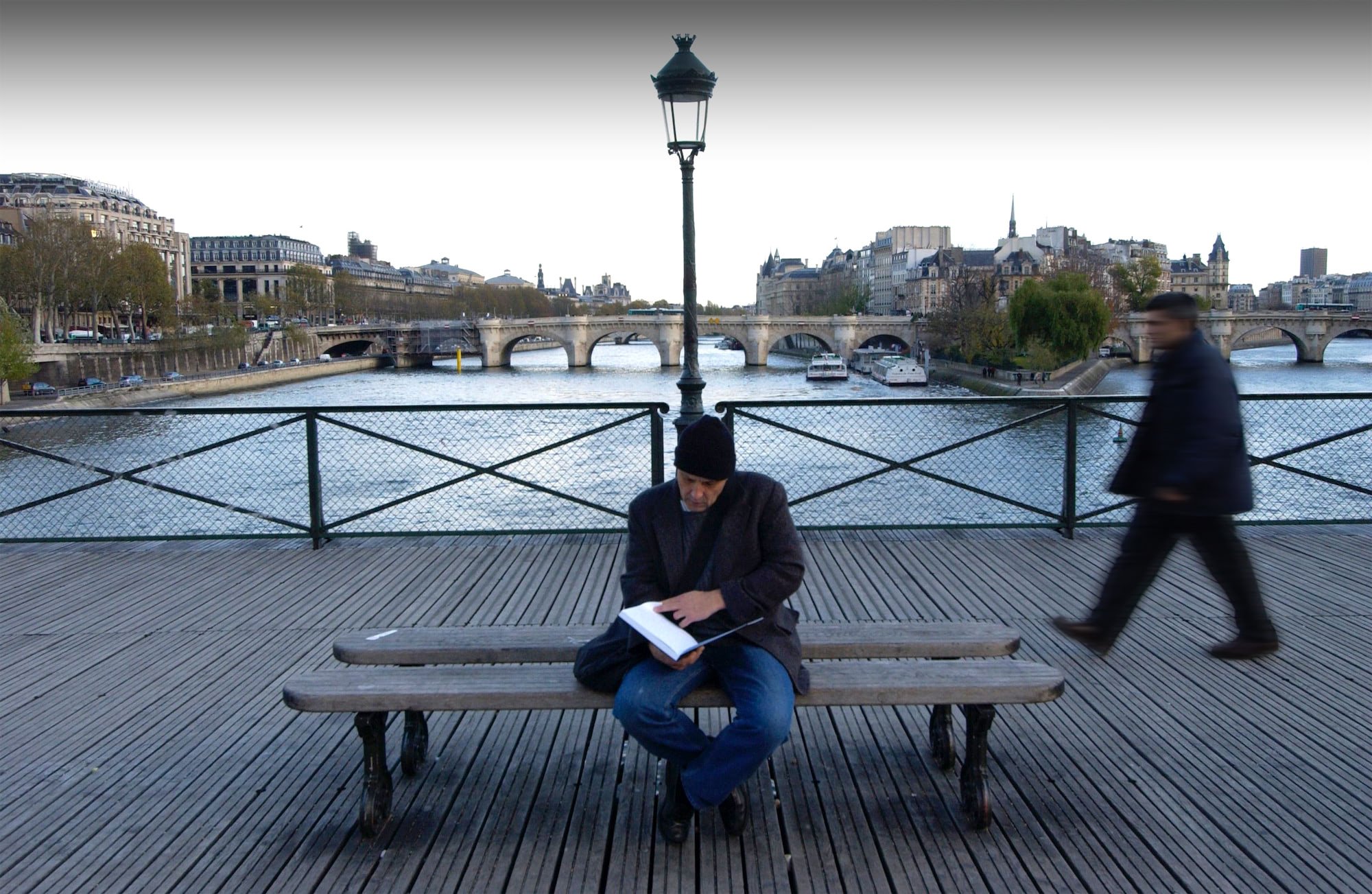
Sunday afternoon in Paris

Sunday Afternoon In Paris

I was walking in Père Lachaise Cemetery in Paris just before Thanksgiving this year. It was cold, cloudy. I passed hundreds of the well attended family tombs with fresh flowers and polished stones that were easy to read:

“À La Memoire de Simantov CARIO, 1906-1942 / Jacques BEHAR, 1873-1943 / Rachel BEHAR, 1884-1943 / Morts à AUSCHWITZ.” 

Scattered among the remembered, were the forgotten tombs with their roofs falling down, brown leaves tangled in spider webs, broken stained glass windows, and doors leaning off rusty hinges bolted into  stone walls crumbling to sand. “That’s where the old stags go,” I thought.